
TR19 Grease — measurement, microns, and what 200μm means
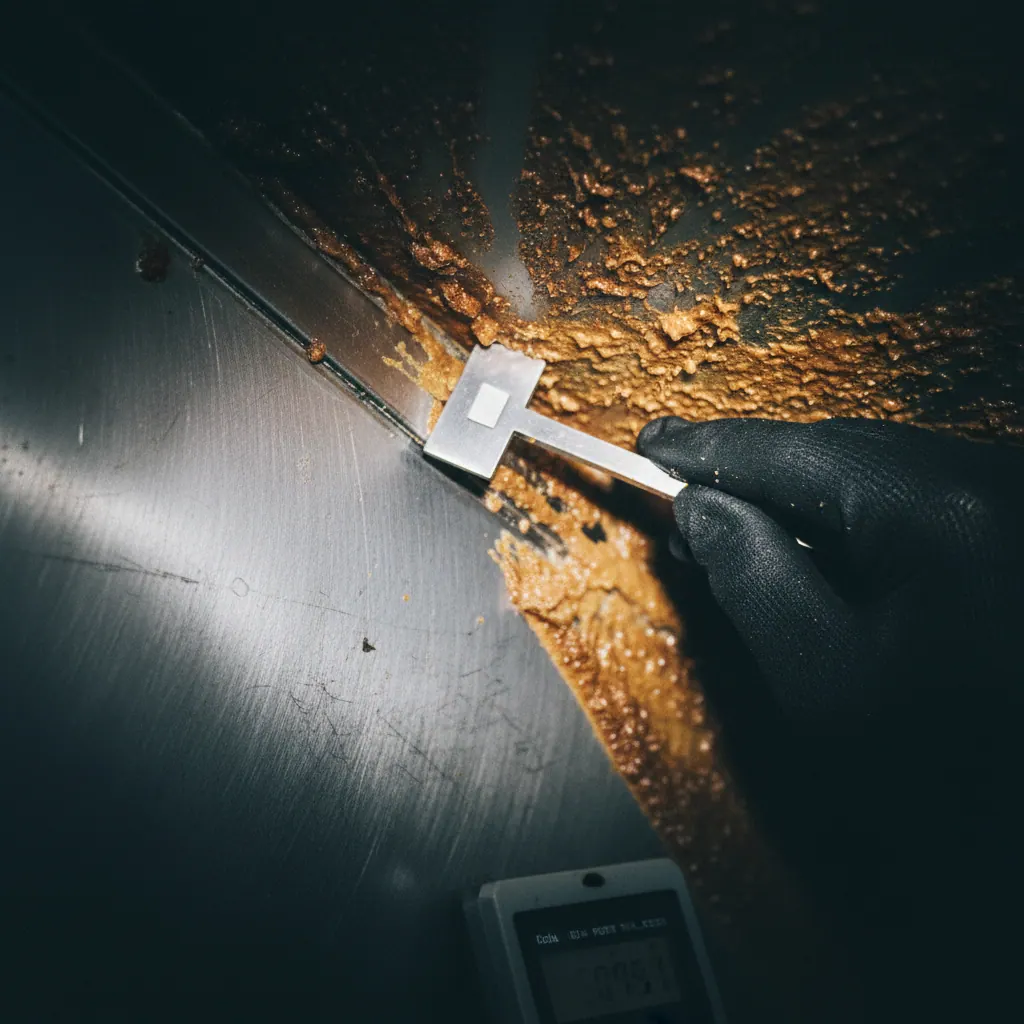
TR19 Grease defines kitchen extract cleanliness using wet film thickness (WFT) — measured in microns. Below 200μm is acceptable; above is non-compliant. The measurement itself is straightforward, but understanding what the number means takes context.
What a micron is
A micron (μm) is one-thousandth of a millimetre. 200μm is roughly the thickness of three sheets of standard A4 paper stacked together. It is a thin film.
How WFT is measured
A wet film thickness gauge — typically a stainless probe with a graduated comb-tooth profile — is pressed against the inner duct wall. The gauge teeth bridge the grease film and indicate the deepest point at which the metal still contacts the substrate. That depth, in microns, is the WFT reading.
Why 200μm and not zero
The 200μm threshold reflects an engineering judgement: it is a level at which grease build-up has begun but is not yet a fire risk. Below 200μm a fire would not propagate along the duct walls; above 200μm it may. The threshold is set as a maintenance trigger, not a permanent state.
How readings are taken in practice
Every access point on the system gets a reading. For a typical restaurant extract: canopy, plenum, vertical riser, horizontal section, fan box — minimum five points. For complex hotel systems, twenty-plus points are normal.
What the readings tell you
Beyond compliance, the pattern of readings tells you where in the system grease is depositing fastest. A high reading at the canopy with low readings deeper in the system suggests the canopy filters are not catching enough grease. A relatively uniform reading throughout suggests the cleaning frequency is too low for the kitchen usage.
Our TR19 certificates record every WFT reading. See our TR19 cleaning service.