
Wet film thickness testing — how it works in practice
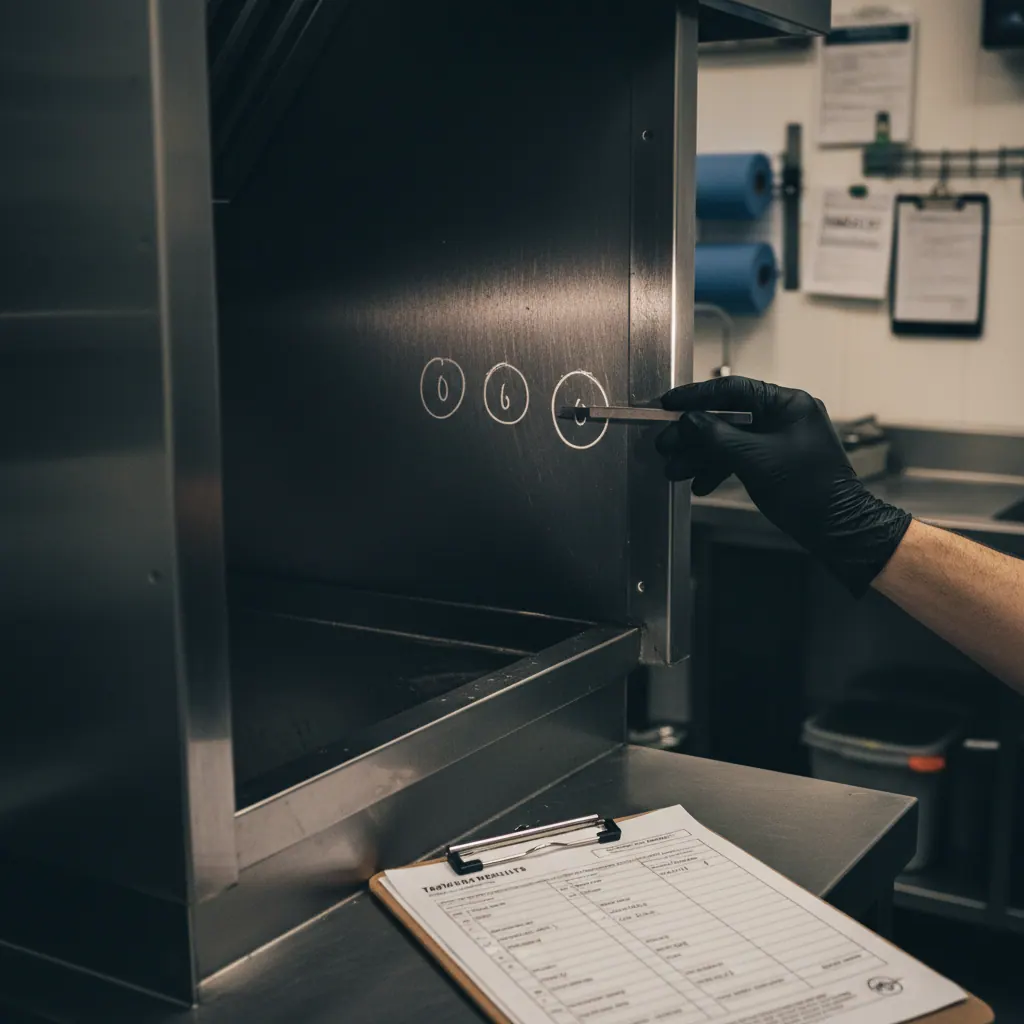
Wet film thickness (WFT) testing is the core measurement underlying TR19 compliance. Every defensible TR19 certificate carries WFT readings. Here is how the measurement is done in practice and what the readings tell you.
The gauge
A WFT gauge is typically a flat stainless probe with a comb-tooth profile, each tooth representing a defined micron depth (e.g. 50μm, 100μm, 150μm, 200μm, 250μm, 300μm). The gauge is pressed against the surface; the deepest tooth still in contact with the substrate metal indicates the WFT.
The procedure at each access point
- The engineer accesses a TR19 access panel on the extract system.
- The gauge is pressed against the inner duct wall — typically three measurements at each access point, averaged.
- The reading is recorded against the access point reference on the system schematic.
- A photograph is taken showing the gauge position and the reading.
Pre and post-clean readings
Both pre-clean and post-clean readings are taken at every access point. The pre-clean reading establishes baseline grease build-up; the post-clean reading verifies the clean was effective. The certificate records both — typically as a paired number like "Pre: 280μm / Post: 50μm" at access point 3.
What good post-clean readings look like
Post-clean WFT readings should be at or near zero — typically below 50μm. Anything above 100μm post-clean indicates the section was not fully cleaned. Insurers and EHOs look for very low post-clean readings as evidence of work quality.
Why every access point matters
A single low reading from a single access point does not demonstrate compliance for the whole system. TR19 requires readings at every access point because grease deposition is uneven — heavy at the canopy, often lighter in horizontal runs, sometimes very heavy at fan boxes. A certificate showing one reading from one point is not defensible.
See our TR19 cleaning service.